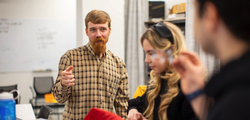
When used responsibly, AI can serve the public good: robotic assistants for people with disabilities; tools to help people express their creative visions; systems that help people improve their wellbeing; and more. Brown CS is partnering with Google Research to offer exploreCSR: Socially-Responsible Artificial Intelligence, a semester-long immersive research experience program for undergraduate students.
Brown CS faculty member Philip Klein was selected as an Amazon Scholar in the Spring semester of this year. The Amazon Scholar Program invites academics to collaborate with Amazon’s teams on technical challenges, offering them the chance to apply their research in a real-world context while maintaining ties to their academic institutions. Klein joins a group of scholars helping to solve complex problems using Amazon’s vast information and physical infrastructure.
Brown CS Master’s student Yumeng Ma (advised by Brown CS faculty member Jeff Huang) has just received an NSF Graduate Research Fellowship for her work in human-computer interaction, specifically at the intersection of human-AI interaction and accessibility. The award is the oldest graduate fellowship of its kind, and aims to recognize and support outstanding graduate students in the fields of science, technology, engineering, and mathematics.
Annually, the Mozilla free software community recognizes 25 people who are leading the next wave of the internet with the Rise25 Awards, which were awarded in Dublin, Ireland, on August 13. Aaron Gokaslan, who received both his undergraduate and Master’s degrees in computer science with Brown CS and is currently a PhD student at Cornell University, was nominated and chosen as a Rise25 honoree for the 2024 cohort.
On May 11, Brown CS faculty member Ritambhara Singh gave a keynote address at the 1st International Caparica Conference on Prescriptomics and Precision Medicine, a biomedical conference on safety for precision medicine, which in its first iteration, focused on how researchers can develop models that leverage the properties of different biological or clinical data types that should be integrated to make accurate diagnostic predictions. Prescriptomics is an emerging field focusing on the complex interplay within genetics and their impact on the effectiveness, safety, and response to precision medicine.
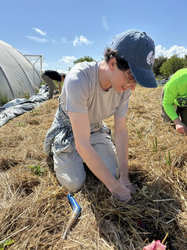
It’s never too late to make a change — just ask Michael Abela. The Brown alum graduated in 2022 with a bachelor’s degree in computer science. In the final semester of his senior year, just months before Commencement, Abela enrolled in a climate solutions course taught by Associate Provost for Sustainability Stephen Porder. To say it was influential is an understatement.
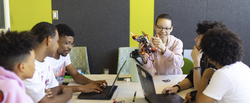
Guided by Brown faculty and staff, Rhode Island high schoolers are completing internships on campus to develop skills and discover career paths in a wide range of subject areas.
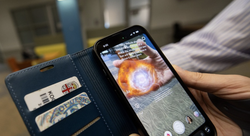
By using a phone camera and a new set of Instagram augmented reality filters, anyone can dive into the depths of space, encountering nebulae, pulsars and even remnants of exploded stars.
A member of the current Brown CS graduating class, Sabrina Chwalek participated in the Brown in Washington program last semester, which welcomes talented Brown undergraduate students who want to apply theory to practice in their concentration area to the District of Columbia. She interned at the Nuclear Threat Initiative (NTI), a nonprofit, nonpartisan global security organization focused on reducing nuclear and biological threats imperiling humanity.
Advancing a commitment to accessible robotics education, the Brown CS PhD student is researching how to simultaneously control multiple drones and teaching others how to build and operate them.