
Leonidas J. Guibas Gives The 25th Annual Kanellakis Memorial Lecture
- Posted by Jesse Polhemus
- on May 21, 2026
The Paris C. Kanellakis Memorial Lecture, a tradition of more than two decades, honors a distinguished computer scientist who was an esteemed and beloved member of the Brown CS community. Paris came to Brown in 1981 and became a full professor in 1990. His research area was theoretical computer science, with emphasis on the principles of database systems, logic in computer science, distributed computing, and combinatorial optimization. He died in an airplane crash on December 20, 1995, along with his wife, Maria Teresa Otoya, and their two young children, Alexandra and Stephanos Kanellakis.
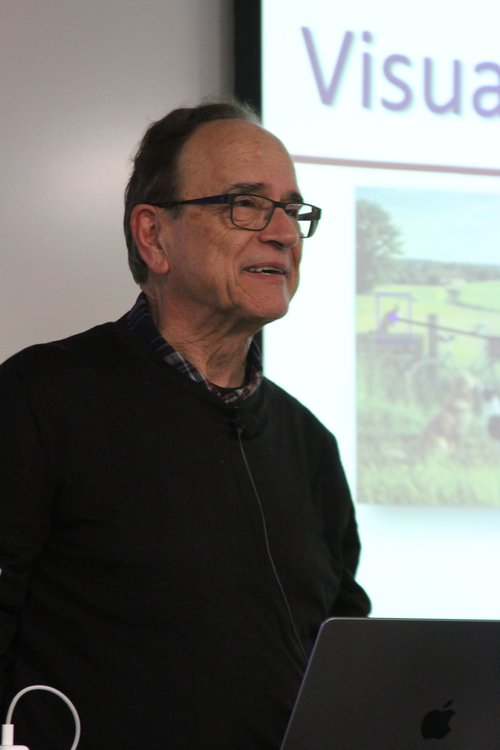
Each year, Brown CS invites one of the field's most prominent scientists to address wide-ranging topics in honor of Paris. Last month, Paul Pigott Professor of Engineering Leonidas (Leo) J. Guibas of Stanford University’s Department of Computer Science delivered the twenty-fifth annual Paris C. Kanellakis Memorial Lecture: “The Space Between The Images – Visual Learning From Relations”.
In his opening remarks, Brown CS faculty member Srinath Sridhar described Leo as a prolific researcher whose interests span combinatorial algorithms, computational geometry, computer vision, computer graphics, machine learning, and robotics, and as someone who knew Paris well.
Taking the stage, Leo began his exploration of the relationships within and across visual data by establishing a chronological framework based on the advent of machine learning techniques: the Pre-Learning Era, the Learning Era, and the Contrastive Learning Era. From the beginning, his fascination with the challenge of drawing useful information from images of all kinds was evident.
“Symmetry is both a way to compress and a way to understand,” he said, “and it’s really kind of amazing how much symmetry there is in both manmade and natural objects.”
Walking his audience through functional maps, which offer a flexible representation of maps between shapes, Leo demonstrated how semantic structure can emerge from a network, explaining that the interpretation of a particular piece of geometric data is deeply influenced by our interpretation of other related data.
As he moved into the Learning Era, Leo first looked back to Euclid and to Cartesian geometry, then noted that for 3D deep learning, the classic solution of data augmentation can both be expensive and sacrifice efficiency. As an alternative, he offered vector neurons, which extend traditional scalar neurons to 3D vectors to process 3D data while preserving rotational information, with applications that extend to robotic manipulation.
“From a single pixel,” Leo declared as he examined semantic structure and compositionality in 3D scenes in the Contrastive Learning era, “we can select an entire semantic entity.” And related pixels, he explained, contain a high level of mutual information, echoing the Hebbian principle of neuroscience that neural networks are formed from the connections of neurons that fire together repeatedly.
But when should we believe the model? Leo described the challenge of complex spatial reasoning as the art of interrogation. Consistency, he said, can be checked even in the absence of ground truth, and instead of trusting, we should verify: “We can know what happens to the answer under a transformation without knowing the answer itself.”
“And then,” Leo said with the curiosity and enthusiasm that characterized the entire lecture, “we can start playing!”
Brown CS faculty member Daniel Ritchie was one of the event’s many attendees.
“I found the last part of the talk,” he says, “on training LLMs to more reliably answer spatial reasoning questions, particularly thought-provoking. His approach to solving this problem is a clever way to get knowledge about spatial reasoning principles out of the symbolic/linguistic part of the model and inject it into the visual processing part via fine-tuning. It got me wondering what other things LLMs ‘know’ linguistically but may be less good at visually, and whether this kind of method could help.”
A recording of the lecture is available here.
For more information, click the link that follows to contact Brown CS Communications Manager Jesse C. Polhemus.


