
Amy Greenwald Receives An IFAAMAS Influential Paper Award
- Posted by Robayet Hossain
- on May 1, 2026
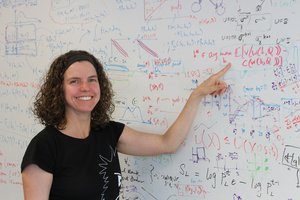
Brown CS faculty member Amy Greenwald and two of her past students have recently been recognized as winners of a 2026 Influential Paper Award from the International Foundation for Autonomous Agents and Multiagent Systems (IFAAMAS), a non-profit organization that promotes science and technology in the areas of artificial intelligence, autonomous agents, and multiagent systems. IFAAMAS established the Influential Paper Award in 2006, and it honors research papers from past AAMAS conferences that have had lasting impact on the fields of autonomous agents and multiagent systems. Presented annually, it recognizes papers published at least ten years earlier that introduced key results, opened new research directions, demonstrated significant applications or systems, or advanced influential new ways of thinking in the field.
Amy was first recognized for work connecting machine learning and game theory in multiagent environments. Her paper “Correlated-Q Learning”, coauthored with Brown CS PhD alum Keith Hall, presented a multiagent reinforcement learning algorithm (MARL) for computing correlated equilibria in stochastic games and examined how reinforcement learning methods can be applied in strategic multiagent settings.
“This paper and the co-winning paper on Nash-Q learning were significant because of how they integrated reinforcement learning with game theory, setting the stage for today’s deep learning MARL algorithms,” Amy says.
She was also recognized for joint work (“A General Class of No-Regret Learning Algorithms and Game-Theoretic Equilibria”) with Brown Mathematics PhD alum Amir Jafari. This paper presented a general framework for defining no-regret learning in terms of sets of alternative strategies and described corresponding equilibrium concepts. The framework and notation introduced in the paper were influential in later research on no-regret learning.
“Although this paper with Amir has only about 100 citations, most modern no-regret papers have adopted this paper’s framework and notation, with many researchers being unaware of its provenance,” Amy says.
The full list of winners is available here.
For more information, click the link that follows to contact Brown CS Communication Outreach Specialist Jesse C. Polhemus.


