
Brown CS PhD Alum Yi-Jing Lin Becomes Taiwan’s Minister Of Digital Affairs
- Posted by Jesse Polhemus
- on Feb. 5, 2026
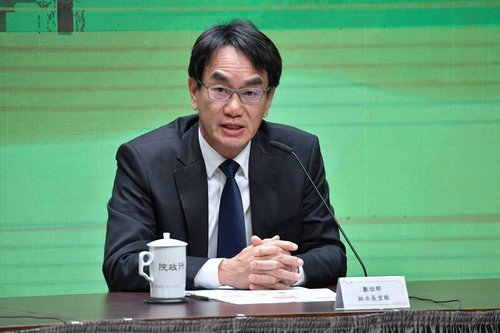
Almost thirty years after earning his doctorate from Brown CS, Yi-Jing Lin’s phone rang, and his already unconventional career took an unexpected turn.
“After the 2024 election in Taiwan,” he remembers, “I got a call from the office of the president-elect, and they asked me to join the government as Deputy Minister of Digital Affairs. A year and a half later, I was promoted to Minister of Digital Affairs, heading a team that’s responsible for promoting AI industry development, strengthening cybersecurity resilience, implementing anti-fraud measures, and enhancing digital government infrastructure.”
After receiving his PhD in 1995 as an advisee of faculty member Steven P. Reiss, Yi-Jing began postdoctoral research at IBM’s Thomas J. Watson Research Center. But the Internet boom had begun, and his native Taiwan was undergoing dramatic political change, so he returned home to join Trend Micro, a cybersecurity company.

“After the internet bubble burst,” he continues, “I decided to found my own company, L Labs, which uses artificial intelligence to teach people to speak English, Chinese, and Japanese. After two decades, I felt that the company had become quite stable and I had some spare time, so I started to write online articles about my career, my family history in Taiwan, and my life at Brown. Somehow, they became quite popular. I have more than 50,000 followers on Facebook and have published two books. Both books became best-sellers in Taiwan ”
“But yes,” he says, “this latest chapter began with that single phone call!”
His new role, Yi-Jing explains, holds challenges both national and international: “Folks from other countries may not know this, but Taiwanese congresspeople are notorious for being very harsh on government officials! Today, Taiwan is at the forefront of geopolitical confrontation. Our systems are under attack from foreign adversaries every minute of every day, and we’re bombarded by misinformation and disinformation. As a country, we fought very hard for our democracy and freedom of speech, and now we’re fighting to keep them.”
Looking back to his time in Providence, Yi-Jing says that he has fond memories of a country that reminded him of the importance of democracy and a university that helped him pursue his love of programming.
“When I came to Brown in 1989,” he notes, “I had been part of a student movement in Taiwan because it was still an authoritarian country. I learned a lot about what democracy means to Americans while I was here, and I brought that back with me when I returned. Our Taiwanese movement was quite peaceful, and eventually we achieved a democracy of our own. And I owe so much to Brown CS and Steve Reiss. I guess I’m a lot like Steve, because I love writing programs. I still work on them every week!”
Yi-Jing hasn’t kept up similarly with his softball game, possibly because he wanted to end that particular career on a high note. While at Brown, he was part of an intramural team that won the championship with an unbeaten record, sometimes winning games by more than 50 points! In one of them, Yi-Jing remembers, he had four home runs and three grand slams.

As readers might expect, artificial intelligence is already playing a massive role in Taiwan’s Ministry of Digital Affairs, with end results that have made headlines worldwide.
“We set up an antifraud app that let Taiwanese people report suspicious posts on social media,” Yi-Jing explains, “and we sent 420,000 suspicious messages to Meta in one year for them to train their model on. The next year, we identified more than seven million messages, and when we asked Meta to look at their IP addresses, they traced them to Cambodia and notified the US government. Soon after, America confiscated more than 14,000,000 US dollars from the Prince Group, a transnational criminal network.”
Even in a moment when AI is beginning to profoundly impact careers in computer science and many other fields, Yi-Jing is adamant that students should follow their hearts: “We can’t imagine what changes artificial intelligence is going to bring, but back in the day, we couldn’t have imagined how the internet would transform things. There was no hardware or software industry in Taiwan in the 1980s, and my father was angry that I wanted to be a computer scientist and not a doctor. When I came to Brown, I realized I could make money from programming, but that’s not what’s important. You can’t predict the future, so find a job you love.”
As we wind down our conversation, it strikes Yi-Jing that two Brown CS faculty members impacted his career in very different ways. Philip Klein, he explains, was walking by the room where he was rehearsing his thesis defense and unexpectedly asked to be a spectator.
“Afterwards,” Yi-Jing says, “I don’t remember his exact words, but he told me that my defense didn’t have a story to it, that everybody needs and loves stories. I wanted to take his advice, but it was too late for my defense. I learned a lesson, though, and I tried to become a storyteller from that day forward. I think I can say that I am now a well-known story teller in Taiwan. I owe that a lot to Philip.”
What Yi-Jing learned from Steve Reiss, he explains, is truly invaluable: “Growing up in Taiwan in the 1970s and 1980s, we were taught to recite from textbooks. I learned the most at Brown from Steve refusing to do the work for me. When I would go to his office and ask for answers, he’d look at me and say, it’s your thesis, you have to find out the solution by yourself. Steve forced me to think, and that was incredibly important. I learned so much because he insisted that I explore for myself.”
Brown CS regularly publishes news articles about our pioneering and innovative alums. We have no financial involvement in any of the companies mentioned above and have not been compensated in any way for this story. The views and opinions expressed above are those of individuals, and do not necessarily state or reflect those of Brown CS, nor does their publication here constitute an endorsement of them.
For more information, click the link that follows to contact Brown CS Communications Manager Jesse C. Polhemus.


