
Jeffrey Mu And Robert Shlyakhtenko Receive The Randy F. Pausch ‘82 Computer Science Undergraduate Summer Research Award
- Posted by Jesse Polhemus
- on May 19, 2026
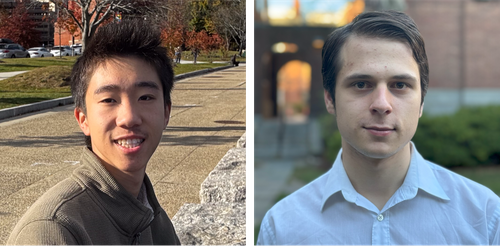
The Randy F. Pausch '82 Computer Science Undergraduate Summer Research Award, given this year to Jeffrey Mu and Robert Shlyakhtenko to support their work with Brown CS faculty members Daniel Ritchie and Robert Y. Lewis, respectively, recognizes strong achievement from undergraduate researchers and offers them the opportunity to continue their work over the summer.
A generous gift from Peter Norvig '78 (a Director of Research at Google and a thought leader in the areas of artificial intelligence, natural language processing, information retrieval, and software engineering) established the award, which provides $13,350 annually to support an undergraduate engaged in an intensive faculty-student summer research partnership. The gift honors the life and work of Randy F. Pausch '82, a renowned expert in computer science, human-computer interaction, and design who died of complications from pancreatic cancer in 2008. “His story is inspiring,” Peter says, “and this is an opportunity to remember him.”
Jeffrey Mu
“My research,” says Jeffrey, “focuses on learning reusable abstractions to give users meaningful control over 3D geometry; it sits at the intersection of computer graphics, machine learning, and program synthesis. While high-fidelity 3D assets are ubiquitous and essential for applications in robotics, digital design, and physical simulation, today's text-to-3D foundation models often produce monolithic geometry that is difficult to refine without time-consuming trial-and-error generations. Programmatic models like procedural or CAD-like representations offer finer-grained control over compositional structure, but require annotated datasets and are brittle to concepts beyond their distribution.”
“Our work aims to combine the strengths of both approaches in an open-universe setting. Given natural language descriptors, we decompose objects into structured programs of named parts. Each part is represented as a parameterized function instantiating differentiable primitives that support shape deformation and generation. Crucially, our system identifies parts directly from arbitrary user-specified semantics, bypassing the issue of solving 3D shape segmentation as a prerequisite, and allowing users to model both manufactured and organic objects. A symbolic program layer and a geometry generation pipeline will work together to validate candidate abstractions that fit many instances of the same semantic part, yielding a reusable library that generalizes across objects. Many users can naturally describe the designs they want in plain language, but current systems don’t reliably convert that intent into a representation that supports creation and iteration. It’s exciting to think our framework would allow users to explore those ideas at the turn of a knob.”
“None of this work would have been possible without the support of my mentors and collaborators. I’m deeply grateful to Daniel, whose guidance, encouragement, and generosity have been invaluable in honing my research maturity and helping me to think more rigorously about the problems that come up in the process. I’m equally grateful for the guidance and patience of my incredible mentors Kenny Jones, Paul Guerrero, Aditya Ganeshan, and other collaborators in the lab, and look forward to continuing this work with the team over the summer!”
Robert Shlyakhtenko
“Computational algebraic geometry,” Robert explains, “is an active area of research which focuses on designing algorithms to compute quantities about objects of interest in algebraic geometry, like curves, surfaces, and their higher-dimensional analogues. Because such algorithms tend to be quite complex, practical implementations are error prone. Our research centers on developing tools that allow us to provably certify the outputs of these implementations, so that the results can be trusted. To do this, we use Lean, a programming language expressive enough to understand and manipulate modern mathematics. Lean allows mathematical statements and proofs to be written as machine-checkable code; a proof accepted by Lean is almost certainly correct. Many algorithms can be implemented and verified end-to-end in Lean, leading to a fully trusted implementation; for other algorithms, an alternative solution is to extract useful information (a “certificate”) from the algorithm that makes verifying the correctness of the output substantially easier. There are several goals to our research: identifying the types of certificates that are useful; investigating what properties of algorithms in algebraic geometry make them more amenable to certification; and finding effective ways to represent abstract mathematical objects (such as polynomial ideals) in ways that can both be computed with and reasoned about mathematically.”
“This summer will be a continuation of a project that started as an independent study course with Professor Rob Lewis last semester. I first became interested in proof assistants and formal verification through Professor Lewis' course, CSCI 1715 (which I highly recommend!). Afterwards, I approached Professor Lewis and asked about the possibility of a project together; since then, his insights and mentorship have been invaluable. I am grateful for the support of the Pausch fellowship and am excited to see what the summer will bring!”
Jeffrey and Robert’s enthusiasm and curiosity are exactly what Peter Norvig is looking for. He sees this award as a multiplier that will amplify the value of his gift and extend it through time. “In the past,” he says, “we had to build all our own tools, and we didn't have time to combine computer science with other fields. Now, there are so many opportunities to do so. I think it's a wise choice: you invest in things that you think will do good, and educating a student allows them to help add to the things that you're already trying to accomplish.”
For more information, click the link that follows to contact Brown CS Communications Manager Jesse C. Polhemus.


