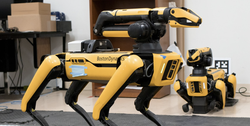
Software developed by Brown researchers can translate expressive and complex plain-worded instructions into behaviors a robot can carry out, all without needing thousands of hours of training data.
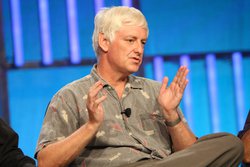
Last month, Brown CS alum John Stasko (now Regents Professor in the School of Interactive Computing in the College of Computing at Georgia Tech) received the 2023 Lifetime Achievement Award from the Institute of Electrical and Electronics Engineers’ Visualization and Graphics Technical Community (IEEE VGTC).
Earlier this year, the international Association for Computing Machinery's Special Interest Group on Computer Graphics and Interactive Techniques (ACM SIGGRAPH) published the second volume of Seminal Graphics Papers: Pushing the Boundaries with the goal of collecting papers from 1974 onward that typify the conference's ground-breaking research. Of the eighty-seven papers included, fifteen have authors who are past or present Brown CS faculty, staff, students, or alums.
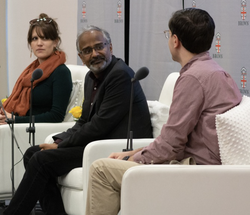
The inaugural discussion in a series convened by Brown’s Office of the Provost and Data Science Institute detailed the history of artificial intelligence and new questions generative AI is raising.
Called VRoxy, the software has the potential to make hands-on collaboration between people working remotely and people working in physical spaces more seamless, regardless of differences in room size.
The Department of Computer Science at Brown University is hiring multiple tenure-track faculty members at the level of Assistant Professor in several strategic research areas:
Next fall, Diana Freed joins Brown CS and Brown’s Data Science Institute as an assistant professor. She’s the latest hire in the multi-year CS With Impact campaign, our largest expansion to date.
Diana is involved in an emerging area of computer science focused on building and designing technologies specifically to improve online safety and well-being for vulnerable and marginalized populations globally. She notes that one theme has been present in her work from the beginning: “The core focus of my research is helping people and improving society, trying to support at-risk and underserved communities. Technology has allowed me to develop …
Now in its fifth year, the Socially Responsible Computing (SRC) program at Brown CS, which helps aspiring technologists keep individual and societal interests at the forefront of their work, has received some significant new support: a grant from the Public Interest Technology University Network (PIT-UN) that will promote curricular changes with wide-ranging implications for CS education. Directed by lead investigators Kathi Fisler and Julia Netter, both Brown CS faculty members, the grant will be managed jointly by Brown CS, Brown’s Data Science Institute, and Brown’s Center for Technological Responsibility, Reimagination, and Redesign (CNTR). PIT-UN is a partnership of 63 colleges …
Brown CS is glad to announce that applications are open for the Randy F. Pausch '82 Computer Science Undergraduate Summer Research Award, which provides $10,000 annually to support an undergraduate engaged in an intensive faculty-student summer research partnership with the Department of Computer Science.
Harini Suresh has ambitious plans for her research in machine learning (ML) and human-computer interaction (HCI), decidedly broad in their scope, but she doesn’t intend to tackle them alone. “Can we imagine new futures for technology,” she asks, “that stem from the needs and desires of people who aren’t currently involved in the process? Would things unfold differently if we involve more people in a way that’s thoughtful and intentional, working together to build technology that reflects our shared values?”