High Performance Design Environments
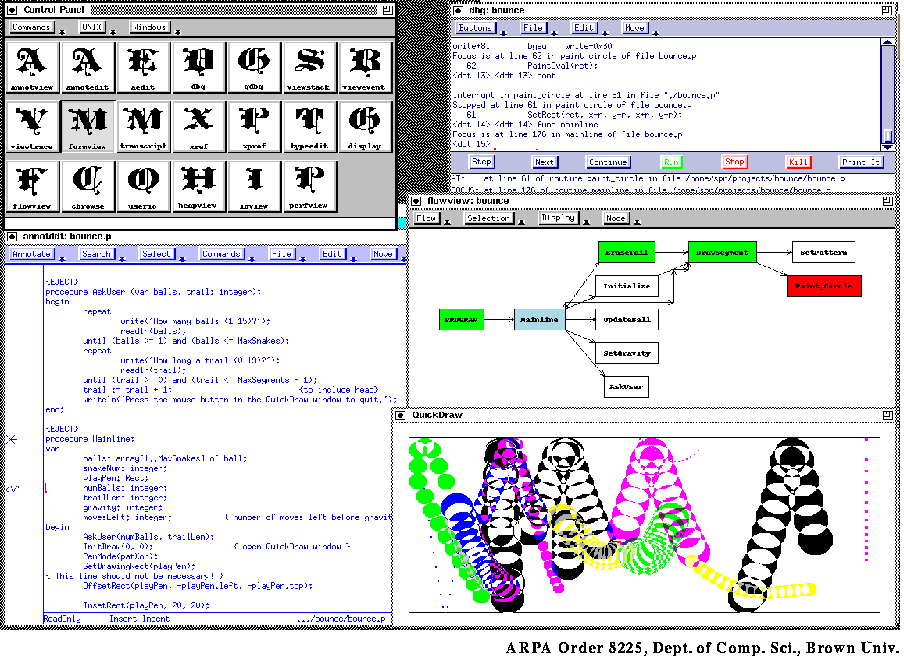
ARPA Order 8225, Dept. of Comp. Sci., Brown Univ.

(Click for full-size image)

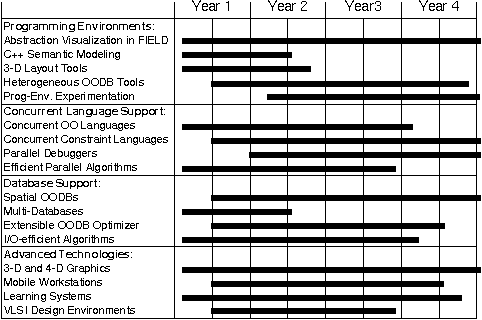
Project Schedule


(ascii version)

BACKGROUND / HISTORY:

  1. Ideographics (83-87)
    PI: John Savage.
    Development of the PECAN programming environment and of various algorithm animation systems.

  2. Multiparadigm Design Environments (87-91),
    PIs: Steven Reiss, Paris Kanellakis, John Savage.
    Development of the GARDEN and FIELD programming environments.
    Development of graphics, oo-database, and programming language technology.

  3. High Performance Design Environments (91-95)
    PIs: Steven Reiss, Paris Kanellakis, Eugene Charniak.
    Building 3D visualization and fragment integration, based on FIELD's control integration.
    Developing 3D graphics, extensible object stores, and constraint languages.

    The GARDEN and FIELD environments have been pioneering efforts in computer science. So has the work on (object-oriented) databases and on graphics.


TECHNICAL APPROACH:

  1. Research on programming environments for high performance applications, in particular on new 3D visualization techniques, debugging techniques, and code optimization methods.

  2. Research on enhancing the performance of specific programming paradigms and on linking them with the prototype environment under development (in particular concurrent constraint-based and concurrent object-oriented paradigms). This is coupled with the study of dynamic, approximate, and parallel algorithms.

  3. Research on key supporting technologies, such as 3D graphics, distributed operating systems, and multidatabases.

    Goals are close to completion on: program integration techniques (FIELD, DESERT), 3D visualization tools (VALLEY), constraint languages (NEWTON), parallel debugging (AARD), database support (EPOQ, AQUA).


OBJECTIVES or GOALS / PAYOFF or BENEFITS:

  1. Objective: Significant increase in productivity of software system designers developing high performance applications.

  2. Objective: Efficient methods for integrating new paradigms into one programming environment (control and fragment integration, a common editor).

  3. Benefits: Development of concepts, tools, reports, and books to support high performance design environments, including: 3-D graphics, object-oriented databases, constraint languages, mobile computing technology, and parallel debuggers.

  4. Benefits: Dissemination of ideas through development and distribution of prototype implementations (e.g., the FIELD environment has significantly impacted practice and has been distributed to more than 700 sites).

TECHNICAL CHALLENGE & KEY IDEAS or CONCEPTS:

  1. Combining control and fragment integration together with a common editor is a major integration effort. This is core of our effort.

  2. The performance of 3D graphics systems is a considerable challenge. Upcoming versions of our prototypes address some of the problems.

  3. Constraint programming technology pushes the state-of-the-art in user interfaces. We have developed one of the first efficient languages for nonlinear constraints.

  4. There has been partial progress in high-performance parallel computing, but also a significant software bottleneck. There has been close collaboration with computational fluid mechanics at Brown.

  5. Scalable distributed computing is a principal challenge, where we are applying our techniques. This is our planned next major effort.

Up Previous
Kathy Kirman