NSF Workshop on Context-Aware Mobile Database Management (CAMM)
Introduction
This is the first of the three planned NSF
workshops. Its objectives are to (a) stimulate and focus interest in the
emerging area of data management for context-aware mobile and pervasive
computing, (b) establish consensus on the key research problems, (c) expose
natural collaboration among the participants, (d) inform the larger research
community of the interest and importance of context-aware data management, (e)
provide NSF with input for future funding initiatives, (f) encourage the use of
standards and shared infrastructure, and (f) create a permanent forum for
evaluating mobile research activities.
The workshop aims to achieve
its objectives by concentrating on the following topics.
·
Application
level issues (data types, data structure, data distribution, data
classification, etc.) of context-aware databases,
·
Develop and
promote common platforms that can be used for cross-fertilization,
·
Develop
efficient algorithms,
·
Develop
prototypes, necessary testbeds, and benchmark suites or case studies for this
discipline, which will evolve over time,
·
Inherent
relationship between data mobility and data processing mobility (moving data,
data caching, data push, data pull, data broadcast, etc.).
·
Web and data
warehouse interface to mobility,
·
Mobile and
intermittent connectivity (location management, handoff, reachability,
optimization, etc.),
·
System
security and recoverability, and
·
Topics related
to terrorism (bioterrorism).
The other major activity of the workshop will be to formally
define those terms, which are frequently used in mobile computing literature.
For example, terms such as “location dependent and location independent data”, “context
aware data”, “mobile query”, “pervasive computing”, mobile security, and so on,
are consistently used but a formal definition of the underlying concept has not
appeared anywhere. The following
sections explain in detail the aspects of context-aware information processing
in a mobile environment.
The Structure of the Information Space
One of the themes of the workshop is how
to manage connectivity and data consistency, availability, sharability, etc.,
in an information space, which could be packed with thousands of mobile
heterogeneous data processing nodes.
Each node could be a peer and capable of processing its needs
independently or in a cooperative manner.
Client-server connectivity may also appear. Such global continuous connectivity is necessary to achieve
ubiquitous processing, which is also referred to as pervasive processing. Thus, for example, a refrigerator can be a
peer node, which can detect the predefined lower level of its contents and
subsequently inform the right component (i.e., the owner of the house) about
this situation. The owner may be mobile
or static and may be located anywhere in this information space. This trigger from the refrigerator may
prompt the owner to trigger next set of activities from his/her present location. Similarly a mobile person can be fully
connected and can perform necessary activities such as bill payment, sending
mail, web browsing, sharing data with other node, etc., from anywhere at
anytime. It is important to note that
in this information space both data and nodes are mobile and the application
data requirements will depend on geographical location. The structure of such information space can
be illustrated with the following figure.
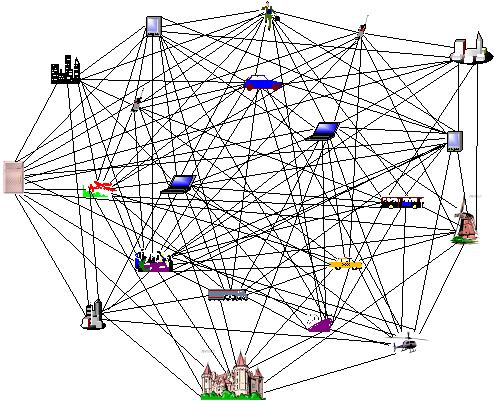
A fully connected information space
Conventional data processing occurs when
there is only data mobility.
Conventional mobile data processing occurs when only some processing
nodes are mobile. Dynamic or ad-hoc
data processing occurs when all nodes are mobile and every node is a peer. The cooperation among these nodes to perform
an activity usually requires a coordinator, which is also referred to as
“Leader”. We have, therefore, an
information space where everything is dynamic, ad-hoc, and unpredictable and
our job in such an environment is to maintain consistency, provide efficient
data access, unlimited sharability, dependable security, system reliability,
system recoverability, and adaptability.
As an example of the kind of system that we envision, consider a traffic
information system that does not depend on a centralized server. More conventional traffic information
systems store all current traffic conditions on a central server, which
introduces its own delays and becomes a single point of failure. While the centralized model is easy to
implement, drivers are typically only interested in information about their
immediate vicinity. Thus, in contrast,
on-board computers could dynamically configure local, ad-hoc networks with
other nearby cars. A particular car
would ask other cars in the area about the traffic conditions that they have
encountered recently. From the data
that is returned, a model of the local traffic would be constructed.
Data mobility in distributed environments
has been studied extensively and we have a number of efficient schemes for
managing it. The mobility of processing
nodes is more complex, especially in the presence of continuous connectivity,
intermittent connectivity, and disconnected processing. We need a new discipline to define research
directions requiring innovative solutions.
In this environment we believe that many of our conventional notions,
for example, consistency, system recovery, integrity, etc., will need to be
redefined. The workshop will thoroughly
discuss these issues and their efficient solutions.
Context-Aware Mobile Databases
We are surrounded by the information space
that is packed with all possible types of data. The contents of the information space are continuously changing
and an application's data requirements may change with time and space. As a result, some data may become irrelevant
(e.g., previous location), some data could acquire new values (e.g., the best
route to Boston), some may acquire new meaning (e.g., the rules governing sales
tax), some data may become stale, some data may become hot and some may become
cold (e.g., the traffic report at rush hour).
Thus, not only the component and the processing activities, the
relationship and interaction among data and its environment are also highly
dynamic and complex. This phenomenon
will increase as more and more devices (e.g., my cell phone) become
computationally enabled and intelligent.
The study of the information infrastructure that is required to support
this environment is referred to as context-aware data management. This forms one of the central themes of this
workshop.
As wireless bandwidth becomes more widely
available, the communication infrastructure will be heavily wireless oriented.
It will provide adaptive connectivity among immobile systems and portable
devices such as cell phones, laptops, and other such future devices. Under this
platform the computing will begin to migrate away from the desktop toward these
devices consequently it will become necessary to managed data more carefully. Industry and academia recognized wireless
devices as an important area for development, however, the problems of data
management have not been addressed in a coordinated manner. This workshop aims
to fill this gap by providing a forum for leading researchers from both
industry and academia in the areas of information management, wireless
networking, communications and signal processing systems to set the research
agenda for the future. This workshop
will lead to a more cohesive research community and will result in a quicker
development and adoption of technologies for this new area. It will facilitate
the development of new standards and will provide the synergy necessary for the
US technical community to become a dominant player in this field.
Workshop Web
The results of the workshop will be made
available online through workshop web site which cab be accessed through the
following two URLs. It will also be
reported in periodicals (e.g., ACM and IEEE) and relevant conferences,
workshops or meetings.
·
http://www.sice.umkc.edu/nsfmobile/wshop.html/
·
http://www.cs.brown.edu/nsfmobile/wshop.html/
Workshop model
The workshop will be conducted by invitation only. There will be (a) invitees from academia,
(b) invitees from Industries, and (c) invitees from NSF. Total number of participants will be around
30 out of which about 10 may be from industries, about 5 from NSF and the rest
from industries. The participants in
this workshop will include well-established senior researchers and new emerging
researchers and advanced developers from both academia and industry involved in
all aspects of mobile systems. Each participant
will present his/her original innovative work, which will be followed by
extensive discussion. We ask that the
presented work should be of highest quality, original, and should be of
practical value.
There will be two invited talks. One invited speaker will be from academia
and the other will be from industries.
Conclusions
It is well established that mobility is
one of the essential trends in today's information processing fabric. An information consumer will demand mobile access
to their data from any platform available to them. Each of the platforms with their widely varying capabilities will
place unique demands on the data management infrastructure. This set of workshops aims to provide
solutions to complex problems of mobility and will set new research directions
for the community. Industrial support is crucial to the objectives of this
workshop. Through this workshop we would be able to reach relevant industrial
organizations and together diffuse the results of our efforts into tomorrow's
information access capabilities. It
should be emphasized that this series of workshops will be unique. While there
are many meetings on the topic of mobility, we intend to design this series to
address context-aware data management. To our knowledge, no such series exists or is planned. We believe that this workshop series can,
thus, serve as catalyst to the formation of a more focused research program. Depending on the results, government
agencies and industrial labs may want to invest in this program in the future.