|
|
|
http://www.yorku.ca/eye/brain2.htm
|
|
|
|
“Visual images are
inverted as they pass through the lens. Therefore, in your right eye, the
nasal retina sees the right half of the world, while the temporal retina sees
the left half of the world. Notice also that the right nasal retina and the
left temporal retina see pretty much the same thing. If you drew a line
through the world at your nose, they would see everything to the right of
that line. That field of view is called the right hemifield.
|
|
So, what you see is
divided into right and left hemifields. Each eye gets information from both
hemifields. For every object that you can see, both eyes are actually seeing
it - this is crucial for depth perception - but the image will be falling on
one nasal retina and one temporal retina.
|
|
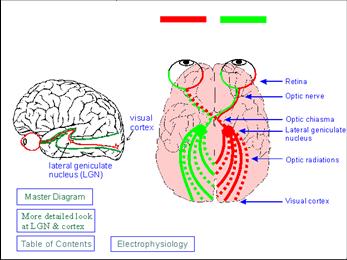
Why bother to divide
the retinas at all? Recall that the brain works on a crossed wires system.
The left half of the brain controls the right side of the body, and vice
versa. Therefore the left half of the brain is only interested in visual
input from the right side of the world. To insure that the brain doesn't get
extraneous information, the fibers from the retina sort themselves out to
separate right hemifield from left hemifield. Specifically, fibers from
the nasal retinas cross over at the optic chiasm - whereas the temporal
retinas, already positioned to see the opposite side of the world, do not
cross. Here is what it looks like:
“http://thalamus.wustl.edu/course/basvis.html Neuroscience tutorial at Wash U
at St Louis
|
|
|
|
|