

1/27/2005
   slide 17
Change in the Nature of Images
•In the past: images and text made in same way, by hand (e.g., Medieval manuscripts)
•Changed in 1450s with Gutenberg’s printing press
•Why no similar technology for images? Text already an abstract, discrete method of encoding meaning (paperback has same content as original manuscript)
•In general, no way to abstractly encode images until computer graphics. Print of a painting not equivalent in content to original…
•Now have abstract (text- and numbers-based) representation of images—images produced are different views of that same data
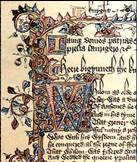
www.luminarium.org/ medlit/elles.htm
In this manuscript, all lettering and drawing done by hand as part of a whole integrated work…

But the difference in the nature of the lettering —the underlying limited alphabet, allowed this part of the manuscript to be reproduced by anyone with finite set of letter forms/ metal letters and punctuation. Don’t even need access to the original to do this!

The beautiful illustration of the initial “W”, though got left behind. There was no abstract language—you’d have to make a printing plate with the full image on it.
No way (in general) to describe it so that someone somewhere else could accurately reproduce it


Computer graphics has changed this, and we’ll be studying how is some depth. For now, suffice it to say that images are empowered by the computer in a truly profound way.

Sources
________
www.luminarium.org/ medlit/elles.htm